
 TXMP Module with ST Micro STM32MP1
 TXMP Module with ST Micro STM32MP1
Best-in-class low-cost, low-power dual-core module
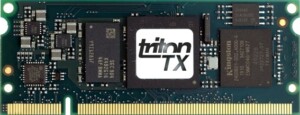 TXMP is at tiny 68mm x 26mm SODIMM system-on-module based on ST Micro’s STM32MP1 processor, specifically STM32MP157C. The module is part of the pin-compatible TX-Module module family. TXMP features a dual-core ARM Cortex-A7 processor running at up to 650MHz and comes with 512MBRAM, 4GB eMMC Flash, and a 24-bit RGB display output, as well as 2-lane MIPI-DSI, 3D GPU, secure boot and crypto capability.
The TXMP is capable of sub 500mW operation, which is exceptional for a dual-core module. In addition, the STM32MP1 processors offer dual CAN, an ARM Cortex-M4 co-processor, as well as a range of additional interfaces including Ethernet, USB 2.0, UARTs, I2C, SPI, PWM and SAI (audio).
TXMP comes with mainline Linux BSP. In common with the rest of the pin-compatible TX-Module family, it requires a single 3.3 to 5.5v supply and provides an up to 300mA 3.3V power output for use on the baseboard.
The STM32MP1-based TXMP brings GPU assisted dual-core performance to the embedded user, at a budget price, in a range of applications including medical devices, industrial products and smart energy devices.
To purchase a development kit, with optional 5.7″ touch screen, simply follow the “Buy Online” link below.
 Download Datasheet and Pinout
 With over 200 successful SoM-based designs completed, Direct Insight is the UK’s leading centre of expertise in this area. Our intimate understanding of the hardware technology and platform software, including Yocto, Debian, QNX and Windows, and associated middleware and frameworks means that we can get you to market quickly and painlessly. We do this by offering expert support, as well as a comprehensive range of services including BSP/Driver development and baseboard design. All customer baseboard designs are checked FoC by our experts.
 Our Linux BSPs are internally maintained, taking advantage of (and contributing to) the latest mainline kernels, and are designed so that you can use them without further development or modification. One of the key advantages of the system-on-module approach is rapid time-to-market, and requires a reliable, production-ready BSP, and a ready-to-roll compatible tools setup. For Linux, we supply a pre-configured VM SDK. QNX BSPs where available are developed in-house by Direct Insight’s engineering team
 Guaranteed lifetime is a key reason to choose us – some TX-Module products have already been shipping for over 15 years. The TX8M module is guaranteed to be available, in small or large quantities until at least 2032. This is a minimum, with expected lifetimes of 15 years where possible. Direct Insight brought the first system-on-module to market in 1999, and has a unique track-record in maintaining partnership with our customers for the long-term, supporting you throughout the product life-cycle.
 Because Ka-Ro TX Modules are designed and manufactured in a high-quality production facility within the EU, there are never problems with manufacturing standards or with supply. If you order 100 modules and we don’t have them in stock, we will make them. Often, cheap modules are produced in large batches by volume-oriented contract manufacturers in the Far East, and once they are gone, they are gone.
 Further to our 10-year longevity guarantee, additional security is provided by the pin-compatible nature of the TX-Module range, which means that suitable baseboard designs can take all the modules from this family, including those based on i.MX6, i.MX8, i.MX9, ST32MP and RZ/GL and allows older modules to be replaced by the latest designs, with new features, better price-performance, and renewed longevity.
With the increasing importance of cyber-security it is more or less essential to include secure boot, in order to meet the authentication requirements of standards such as EN18031 and the CRA. We offer the addition of secure boot to your development process (with and without encryption) as an expert service. We also offer HAB/AHAB programming during manufacture to enable customers to easily secure their device.
| Resource | TRITON-TXMP | Detail |
|---|---|---|
| Processor | ST Micro STM32M1 | STM32M157C |
| CPU | 2x ARM Cortex-A7 | includes Neon SIMD / VFP |
| Processor Clock Max (MHz) | 650 | |
| RAM (MB) | 512 | DDR3L |
| Persistent Storage | 4GB | |
| Floating Point | y | ARM Cortex-A7 Neon VFP |
| UART (RS232) | 3 | 3 in standard pinout, others available via alternate pin functions |
| Ethernet 10/100 BaseT | 1 | |
| I2C Interface | 2 | |
| LCD Controller | 1 | 24bpp, 1366x768. MIPI-DSI and parallel RGB |
| Supplied LCD | 640x480 | Capacitive touch, other sizes on request |
| SSP (synchronous serial /digital audio) | 1 | SAI2: on headers. Codec on baseboard |
| SD card/SDIO (4-bit) | 1 | 4-wire, SD Card receptacle on baseboard |
| USB Host | 1 | Includes PHY. Single "A" type socket on baseboard |
| USB OTG | 1 | Includes PHY. Micro AB socket, on baseboard |
| SPI | 1 | |
| PWM Controller | 1 | |
| JTAG | 1 | Special pads on base - refer to docs |
| Analog Audio | ** | codec on baseboard |
| CAN | 2 | |
| Temperature Range | -25C to +85C | |
| Dimensions | 68 x 26mm | |
| Connectors | SODIMM200 | TX-Module range compatible pinout |
| Power Consumption | 800mW | Linux prompt |
| Guaranteed Longevity | 2033 | Expected life to processor EOL |
| Linux | y |
Main board-7 provides a complete development environment based on TRITON-TXMP, running mainline Linux out-of-the-box. The development system consists of a baseboard which provides an unpopulated bank of 0.1″ headers for all 200 module pins (including PCIe), plus connectors for all the main module interfaces, and includes additional peripherals such as an SGTL5000 audio codec. Other connectors include USB, Ethernet, SDCard, CAN, RS-232 and RS-485. The Mainboard-7 offers an optional 640×480 capacitive touch screen, and an LVDS output to enable connection of other screen sizes. Please note that the kit uses the RGB display output – if you are thinking of using MIPI-DSI, please discuss this with us before purchase.
For production purposes, you will require a custom baseboard, and we are happy to offer baseboard design and manufacture as a service.
The TRITON-TXMP is available in the following configurations.
TXMP/153A/256R/4GF/E – with 256MB RAM, 4GB eMMC Flash, -25C to +85C extended temp.
TXMP/157C/512R/4GF/E – with 512MB RAM, 4GB eMMC Flash, -25C to +85C extended temp.
Simply order the Mainboard-7 for TRITON-TXMP development system via our online shop, using the “Buy Online” link to the right, and it should be with you in a couple of days. We look forward to providing you with knowledgeable, professional support to create your product. If you have questions, please don’t hesitate to contact us by calling Direct Insight on +44 1295 768800 9am to 5.30pm UK time, emailing info at directinsight.co.uk, or by using the “Contact Us” form below.
You can quickly access volume pricing information using the “Get Quote” link to the right.
