
QS8M Solder-down module with NXP i.MX8M Mini Quad and Nano Dual

QFN Style System-on-Module with Quad or Dual Core ARM Cortex-A53 processors
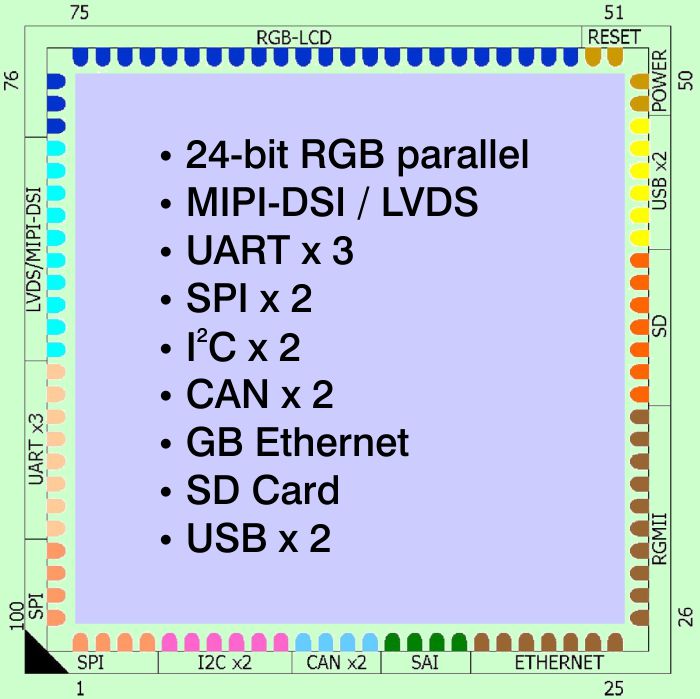
The new QS8M is a QFN Style solder-down system-on-module series with NXP’s 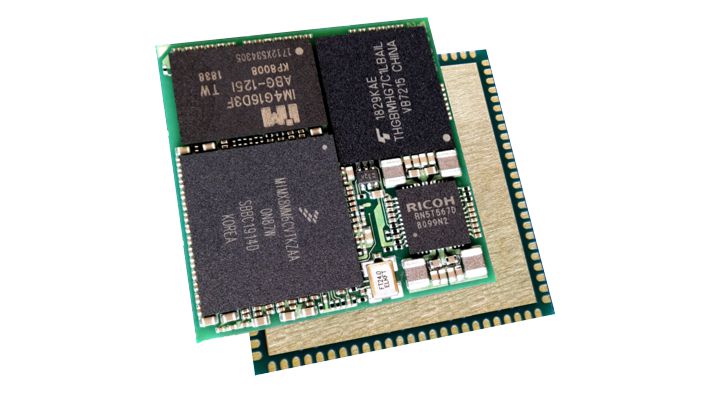 latest dual and quad-core i.MX8M Mini and Nano ARM Cortex-A53 64-bit processors, plus RAM, Flash memory and power management. The module is square, and just 27mm in width, with a height of 2.3mm. Its QFN-type pinout style features a 1mm pitch with 100 pads providing unparalleled miniaturisation, thermal efficiency and EMI minimisation – the base functions as both a ground pad and a thermal conductor. The module requires a single 3.3v supply.
The QS8M module’s i.MX8M family processor provides a dual core – in the case of i.MX8M Nano, or quad core for i.MX8M Mini 1400/1600MHz ARM Cortex-A53 processor complex as well as a separate GPU and Video Codec (Mini only). There is up to 1GB of DDR3L RAM, and 4GB eMMC Flash, with an extensive range of interfaces (see table). The i.MX8M Nano and Mini combine low energy operation with powerful features including MIPI-DSI display up to 1080p. Both modules offer an industrial temperature spec of -25C to +85C. The modules provides a wide range of connectivity including CANbus , UART s, SPI, I²C, Audio, Ethernet, SD, USB Host and Client and MIPI-DSI display.
The QS8M series offers a dedicated development system, equipped with Linux BSP (Windows 10 IoT and QNX also available)
To purchase a development kit simply follow the “Buy Online” link below.
 Download Datasheet and Pinout
| Resource | QS8M | Detail |
|---|---|---|
| Processor | NXP i.MX8M Mini Quad or Nano Dual | |
| CPU | 2/4x ARM Cortex-A53 | Nano Dual or Mini Quad |
| Processor Clock Max (MHz) | 1400/1600 | Nano/Mini |
| RAM (MB) | 512/1024 | Nano/MIni |
| Persistent Storage | 4GB | 4GB eMMC |
| Coprocessors | GPU, VPU | VPU on Mini only |
| Floating Point | y | ARM Cortex-A53 Neon / VFP |
| Real-Time MCU | y | Cortex-M4F/M7 subsystem |
| UART (RS232) | 3 | |
| Gb Ethernet | 1 | |
| I2C Interface | 2 | |
| LCD Controller | 1080p | MIPI-DSI, 4-lane |
| Supplied LCD | 1280 x 800 | 10.1" capacitive touch with TX8MDK. |
| SAI Audio | 1 | |
| S/PDIF | 1 | |
| SD card/SDIO (4-bit) | 1 | |
| USB OTG | 2/1 | Mini/Nano. Hub on baseboard |
| SPI | 2 | |
| PWM | 1 | |
| JTAG | 1 | Special pads on base - refer to docs |
| Camera Interface | 1 | MIPI-CSI |
| RTC | 1 | |
| Temperature Range | -25 to +85C | |
| Dimensions | 27mm x 27mm | 2.3mm height |
| Power | 510/60 (500/45) | Power/Sleep Mini (Nano) |
| Connectors | 100-pin QFN | QS range compatible pinout |
| Longevity (years) | 12 | Guaranteed supply to 2033 |
| Linux | y | Mainline, Yocto Project compatible |
| QNX | y | 7.0 |
| Windows 10 IoT Core | TBA |
 The QS8M module has its own development kit, supplied with Linux running out of the box.
The development kit features a Raspberry Pi compatible expansion header and TFT interface – so you can implement interfaces in development using RPi hats and displays.
It is supplied with a QS8M-MQ00 module, with quad-core i.MX8M Mini, 1GB RAM and 4GB eMMC. There is MIPI-DSI connector for a touch screen , MIPI-CSI camera port, and connectors for SD Card, Gb Ethernet, 4x USB Host. USB client and power supply, and debug UART. Additionally there is a 40-pin expansion header and all 100 module pins are brought to 0.1″ solder pads. For production purposes, you will require a custom baseboard, and we are happy to offer baseboard design and manufacture as a service.

QSBASE4 with Raspberry Pi Display
All QS and QSX modules may use the QSBASE4 baseboard for development purposes.
QSBASE4 is designed to accept socketed versions of all QS and QSX modules, and features:
- Gb Ethernet
- 2-port USB hub
- 2-Lane MIPI display connector – Raspberry Pi compatible
- 2-Lane MIPI camera connector
- Micro USB to UART bridge for debug
- USB type-C connector for client/power
- Expansion connector – RasPi power/I2C/SPI/UART compatible + CAN, SDIO
- JTAG ICE header

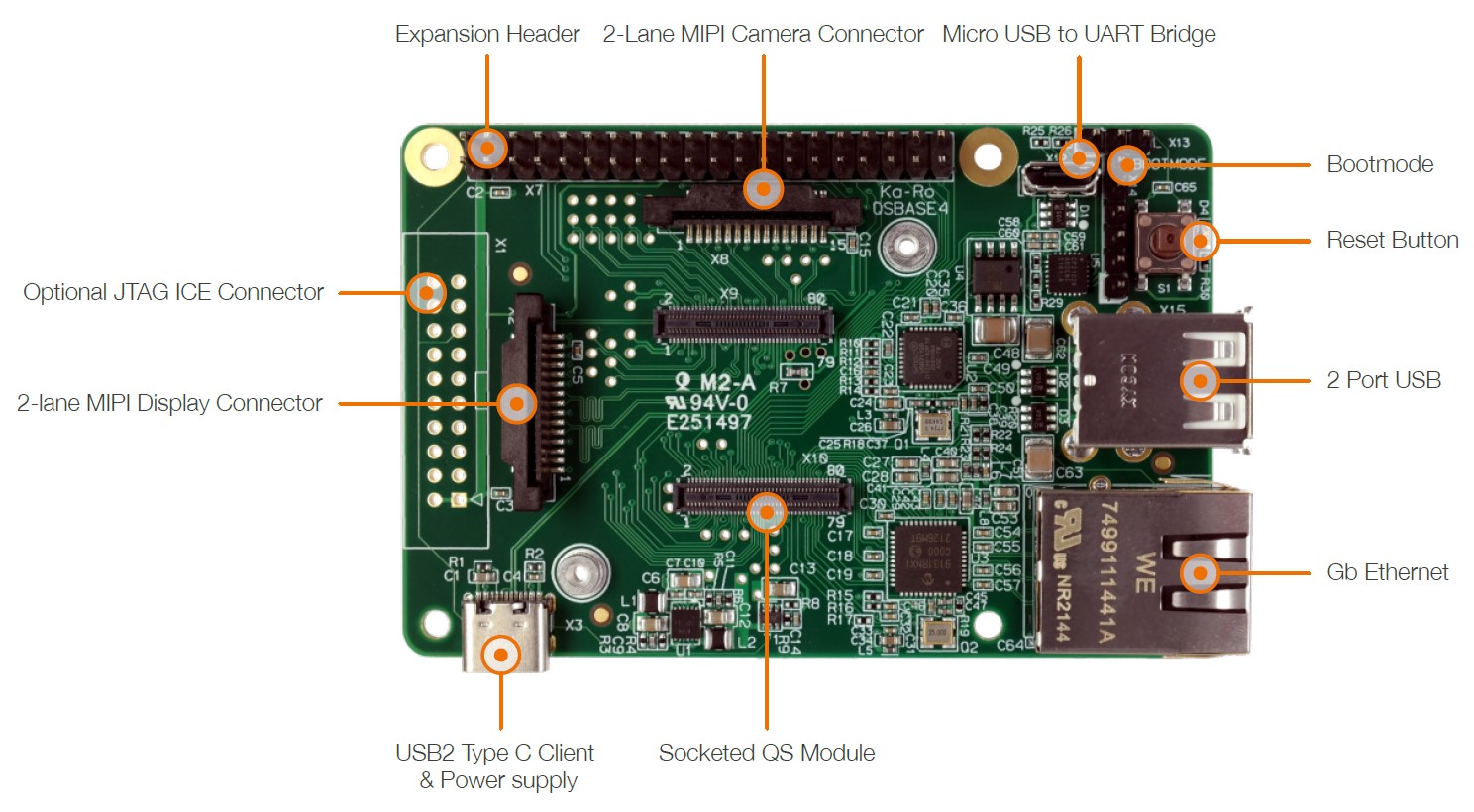
Special socketed versions of QS/QSX modules are connected via two 80-pin push-down connectors.
The QSBASE4 works with a standard Raspberry Pi 7″ touch display which is readily obtainable (we may also have stock). It is supplied complete with a USB-C cable for power and flashing, and a micro USB-B cable for debugging. The socketed modules are preflashed with a Linux image (contact support for details, and possible customisation).
The QS8M module is available in two standard configurations, with further options based on MOQ. See the comparison table below (also the feature table above), and the part descriptions below the table.
| QS8M i.MX8M Mini | QS8M i.MX8M Nano | |
|---|---|---|
| Primary Processors | 4x ARM Cortex-A53 | 2x ARM Cortex-A53 |
| Clock | 1.6GHz | 1.4GHz |
| Secondary Processor | ARM Cortex-M4F | ARM Cortex-M7 |
| RAM | 1GB | 512MB |
| USB 2.0 | 2 | 1 |
| Video Codec | 1080p60 | - |
| GPU | OpenGLES 2.0, single shader | OpenGLES 3.1, OpenCL 1.2, Vulkan, dual shaders |
QS8M-MQ00 – with i.MX8M Mini quad-core processor, 1GB RAM, 4GB eMMC Flash, -25C to +85C industrial temp – available in packs of 10
QS8M-ND00 – with i.MX8M Nano dual-core processor, 512MB RAM, 4GB eMMC Flash, -25C to +85C industrial temp – available in packs of 10
Available MOQ options include 256MB RAM, and full industrial temp range (-40C)
Simply order the QS8M development system via our online shop, using the “Buy Online” link to the right, and it should be with you in a couple of days. We look forward to providing you with knowledgeable, professional support to create your product. If you have questions, please don’t hesitate to contact us by calling Direct Insight on +44 1295 768800 9am to 5.30pm UK time, emailing info at directinsight.co.uk, or by using the “Contact Us” form below.
Contact our experienced team with your detailed questions – we’ll be happy to help.
You can quickly access volume pricing information using the following link: Get Quote
Development kits and sample/spare modules are available from stock
QSBASE4 development kit (requires QS8MM socketed module, or QS8MN socketed module)
QFN-Style SoM Advantages
For larger volume applications, or where a tiny footprint is needed, Ka-Ro QFN solder-down modules fit the bill perfectly.
In addition they offer:
 Guaranteed lifetime is a key reason to choose us – we have been shipping modules for over two decades, and have a track record of offering several products for well over 10 years. Each module that we sell is guaranteed to be available, in small or large quantities for at least 12 years from launch. This is a minimum, with expected lifetimes of 15 years where possible. Direct Insight has a unique track-record in maintaining partnership with our customers for the long-term, supporting you throughout the product life-cycle.
 Because the TRITON-TX modules are manufactured in a high-quality small-batch production facility within the EU, there are never problems with manufacturing standards or with supply. If you order 100 modules and we don’t have them in stock, we will make them. Often, cheap modules are produced in large batches by volume-oriented contract manufacturers in the Far East, and once they are gone, they are gone.
 Our BSPs whether for Linux, or other supported OS including QNX and Windows 10 IoT Core are complete, and are designed so that you can use them without further development or modification. One of the key advantages of the system-on-module approach is rapid time-to-market, and requires a reliable, production-ready BSP, and a ready-to-roll compatible tools setup. For Linux, we supply a pre-configured VM SDK so that the kit and tools are ready to use out of the box.
 Further to our longevity guarantee, additional security is provided by the pin-compatible nature of theQS-Module ranges, which means that suitable baseboard designs can take all the modules from this family, from the low-end low-cost QSMP, to the i.MX8 based QS8M and allows older modules to be replaced by the latest designs, with new features, better price-performance, and renewed longevity.
 Striving for the best technical support provision to our customers is what makes Direct Insight stand out. Using a system-on-module is all about achieving a quicker, smoother route to project completion. We have supported our customers in many hundreds of system-on-module projects over the last 20 years, and are uniquely placed to assist you.
i.MX8 processors have a sophisticat ed feature called High Assurance Boot (HAB) which potentially allows the user to secure the device against code modification, while preserving the ability to update. This is achieved by programming public keys into the device, against which the private-key signed image and data are validated. We offer HAB programming during manufacture to enable customers to easily secure their device.
